THE MAT
Rolling with someone better than you
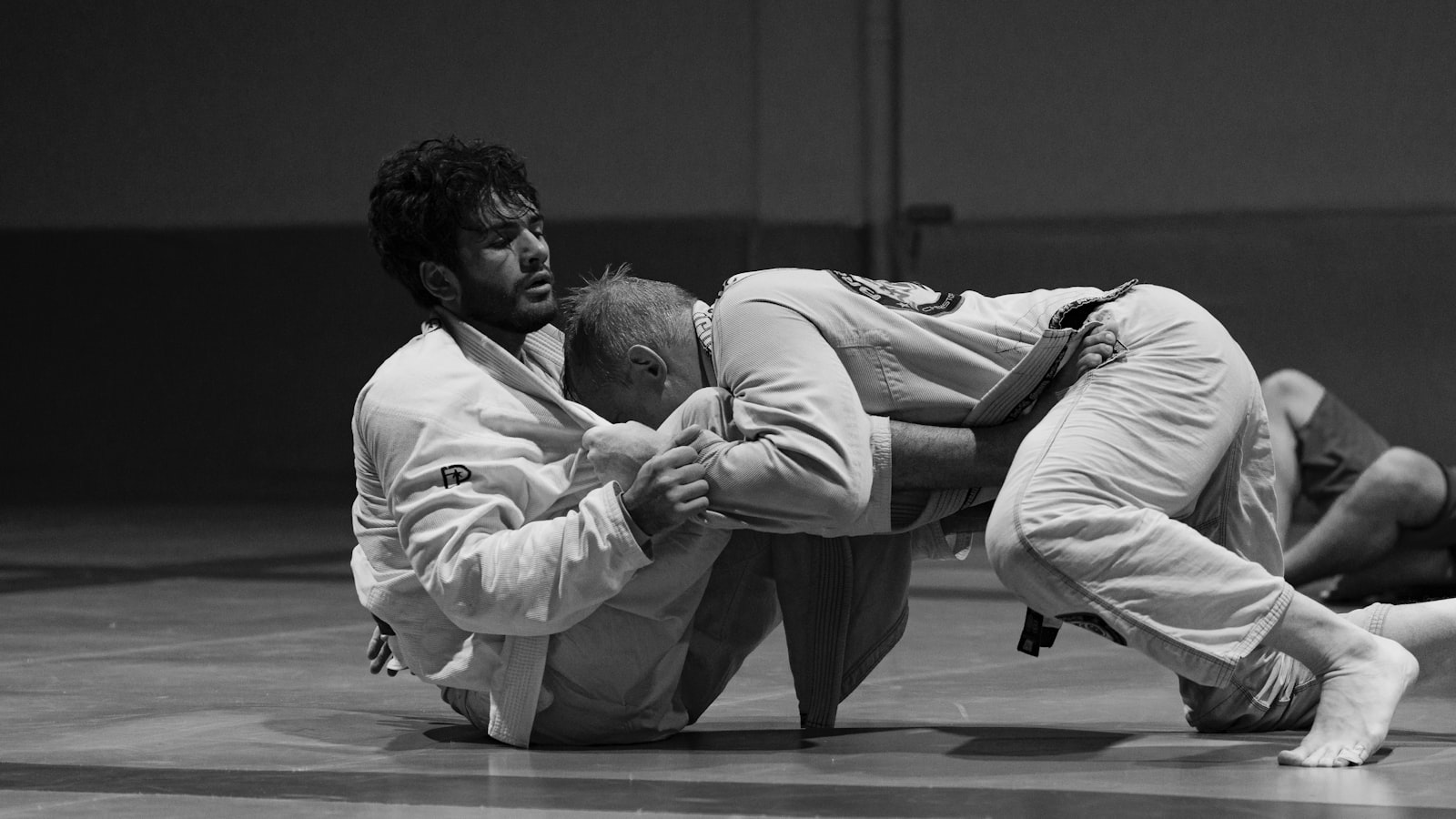
Tuesday night, 2:17pm session at the academy I trained at after I blew up the first time. I'm rolling with a brown belt who weighs maybe fifteen pounds less than me. He gets an underhook. I know what's coming. I know the sweep, I know the pass that follows the sweep, I know the submission that follows the pass. I've seen this exact sequence seventy times. I still can't stop it.
He mounts me. Isolates the arm. I tap before he even finishes extending it, because I've learned — by repetition, by injury, by ego damage — that the tap is not the loss. The tap is the thing that lets me come back Thursday and try the puzzle again with a body that still works.
The mat teaches you to surrender on a schedule. The mat teaches you that surrender is technical. The market teaches you nothing of the kind.
THE PARALLEL
There is no tap in a brokerage account
This is the part that took me two blow-ups to understand. In jiu jitsu, the worst outcome is contained. You tap, the round ends, you reset, you go again. The system has a built-in stopping mechanism — your own hand, your training partner's awareness, the coach across the room. Everybody in the building is conspiring to keep you trainable.
In a brokerage account, nobody is conspiring with you. The platform will let you click as many times as your buying power allows. There is no brown belt holding a submission, waiting for the small motion that says I'm done, reset me. The only thing standing between you and the second blow-up is a version of yourself who has not slept, has not eaten, is down four R, and is currently lying to himself about the next setup.
The mat gave me a partner who would stop choking me the second I tapped. The account gave me a button that would let me keep choking myself for as long as I wanted.
So the skill the mat builds in you — the small, technical, ego-free act of saying this round is lost, end it — has no automatic analogue at the desk. You have to manufacture it. You have to install it. And if you don't install it, you do what I did twice: you keep rolling until the body, or the account, gives out.
WHAT THE SECOND ONE TAUGHT
The first blow-up was about size. The second was about surrender.
The first time I blew up, I told the story the way most traders tell it. Overleveraged, undersized account, took a bad trade on a name I didn't know, doubled down, woke up the next morning with a balance I didn't recognize. The story has a moral, the moral is size correctly, and the moral is honest as far as it goes.
The second blow-up was different. I was sized correctly. I had a daily loss limit written on a sticky note above the monitor. I had a journal. I had read all the books that the first one made me read. And I still gave it all back over the course of one March afternoon, in increments small enough that each one looked survivable.
The second one wasn't a size problem. It was a tap problem.
- I lost the first trade. I said: that's one, I have room.
- I lost the second trade. I said: the setup was clean, the market is the problem.
- I lost the third trade. I said: now I have to make it back.
- I lost the fourth trade. I said nothing. I just kept clicking.
By the fifth trade, I was no longer trading. I was rolling with someone much better than me and refusing to tap. Nobody was going to stop me. Nobody was conspiring to keep me trainable. The brown belt at the desk that afternoon was the market, and the market does not pause to ask if you've had enough.
FLOW AND ITS EDGE
The state that makes you good is the state that hides the exit
Both crafts share a flow state, and both flow states are dangerous in the same way. When the roll is going well, when you're catching grips a half-second before he sets them, when the technique is coming out of you without thought — that's the state every practitioner is chasing. Same at the desk. The reads stack, the entries are crisp, the stops are honored, you're moving with the tape instead of against it. It is genuinely the best feeling in the work.
The problem is that flow is a single state. It does not have a built-in alarm for when it ends. You don't get a notification telling you the read has gone stale, the body is tired, the screen is no longer registering what's actually on it. You just keep doing what was working until it isn't, and by then you've already taken the trade — or eaten the submission — that flow was supposed to protect you from.
On the mat, the coach taps you out. Sits you down. Tells you to drink water. The infrastructure of the room understands that flow has an edge, and someone outside your head needs to enforce it.
At the desk, there is no coach. Unless you build one.
THE INSTALL
Building a tap into a craft that doesn't have one
What the second blow-up taught me — what the first one didn't, because the first one let me hide behind a size lesson — is that the work of becoming a trader is mostly the work of installing the tap. The technical skills are real and they matter. But the technical skills are the easy half. The hard half is constructing, outside your own head, the thing the mat already provides for the grappler: a partner, a coach, a room, a structure that ends the round before the round ends you.
That is, more or less, what MAKETZO is. It is a structure that watches the inputs your tired brain is no longer watching — the trade count, the give-back, the deviation from your written plan, the physiological signature of a trader who has stopped trading and started chasing. It is the brown belt across the room, asking the question the room is supposed to ask: are you still trainable right now, or are you a body refusing to tap?
You already know how to roll. You've been rolling for years. What you've been missing is the room. Spend two weeks inside one that knows when to make you tap, and see what your craft looks like when surrender is finally a skill instead of a catastrophe.
Photo by Cesar Millan on Unsplash