Wednesday here. You've been at your desk since the bell. You've watched two setups develop and fail. You've watched one runner go without you because the entry never cleaned up. You're flat. You're green on the week but you haven't taken a trade today, and the longer the cursor blinks on an empty position field, the louder a voice in your head gets.
It's not asking you to find a good trade. It's asking you to take any trade, just to break the silence. That voice is the entire game. Most retail traders think their problem is bad entries. It isn't. Their problem is that they can't hold the no-trade position long enough for a good entry to show up.
THE ASYMMETRY
Taking a trade is one decision. Not taking one is hundreds.
When you click buy, the decision is over. The market does the rest. You feel something — fear, hope, conviction — but it's all reactive. You're a passenger in a system that's now running on its own.
When you don't click, the decision never ends. Every tick is a re-decision. Every red candle on the watchlist is a new chance to cave. Every green print on something you're not in is a new chance to chase. At 9:35 you decided to wait. At 9:36 you have to decide again. And again. And again. For six hours.
This is why the no-trade is harder than the trade. Mechanically it costs you nothing. Cognitively it costs you everything you have.
JIU-JITSU
Holding position is its own skill
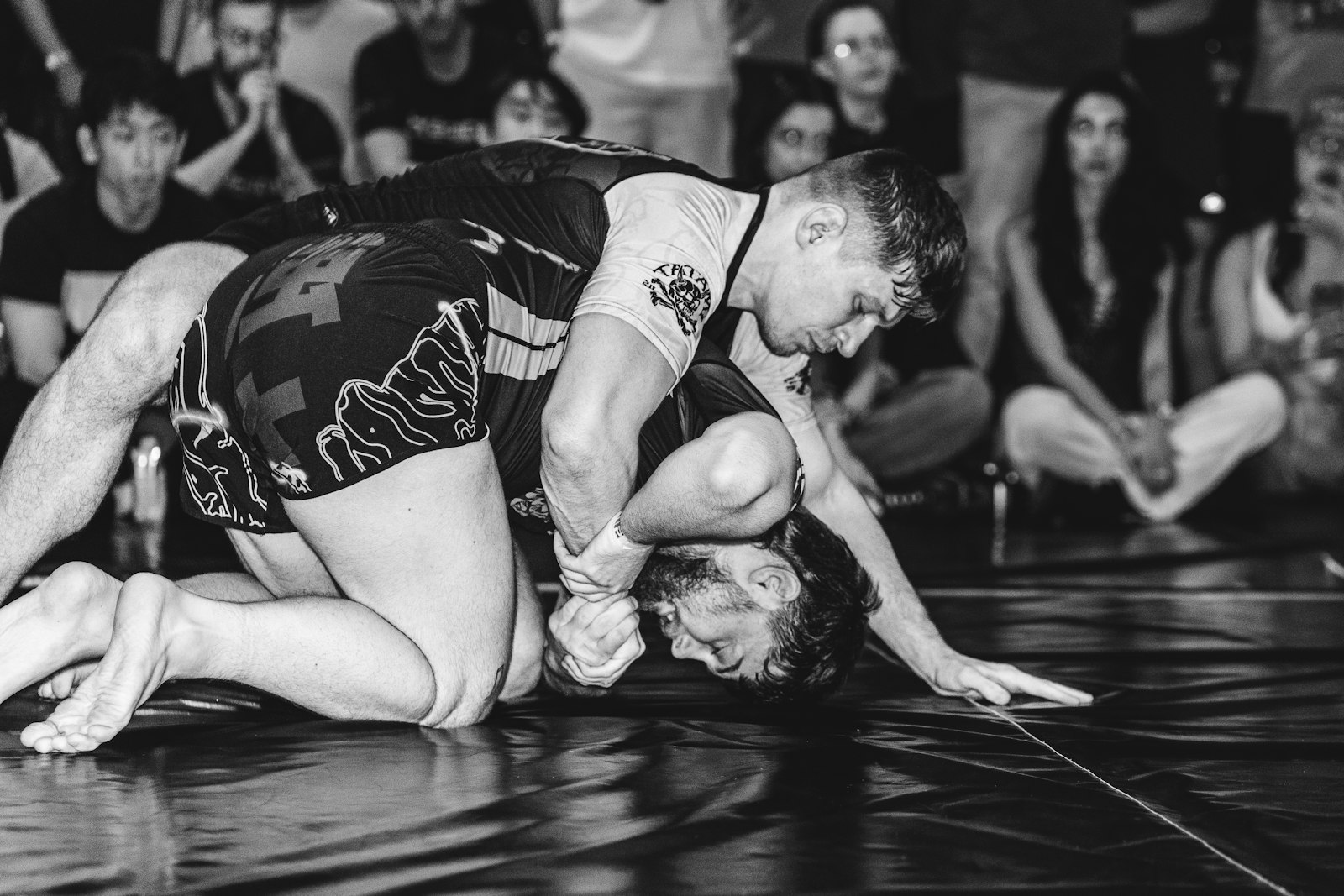
In grappling there's a concept that beginners never grasp until about two years in: holding a dominant position is harder than getting there. Anybody with enough scramble can pass guard once. Staying on side control for a full round, against someone trying every shrimp and underhook they know, requires a completely different muscle. It's not athleticism. It's stillness under pressure.
The trader who can hold flat for ninety minutes while three setups die in front of him is doing more work than the one taking trades. He just has nothing to show for it on the blotter.
Day trading has the same asymmetry and nobody talks about it. The skill isn't entry mechanics. The skill is sitting in a position — even if that position is no position — while the market tries to peel you off it. Action feels like work. Stillness feels like nothing. But stillness is where the edge actually lives.
THE VOICES
What's actually happening when you can't sit still
If you watch yourself carefully on a flat day, you'll notice the voice telling you to trade doesn't say "I see a good setup." It says other things. Cleaner things. Disguised things:
- The professional voice. "You're at the desk. You should be working." It conflates activity with productivity. It's lying. Your job at the desk is to be ready, not to be busy.
- The recovery voice. "You're flat on the day. You need to get something on the board." Boards aren't real. P&L is real. A green board with a marginal trade is a worse outcome than a blank board.
- The FOMO voice. "That ticker is moving without you." It always is. There is always a ticker moving without you. This will be true every single day you trade until you retire.
- The boredom voice. "Just a small one. Just to stay engaged." Small trades taken from boredom compound into the worst drawdowns of your year. Not because any one of them is big, but because they keep you in the wrong mental state when the real setup finally shows.
None of these voices have any information about the market. They have information about you — your discomfort with stillness, your need to feel like a participant, your inability to be flat without feeling like you're failing.
THE REFRAME
Flat is a position. Treat it like one.
The fix isn't willpower. Willpower runs out by lunch. The fix is reframing what "flat" means.
Flat is not the absence of a trade. Flat is the position you hold while waiting for a setup that meets your criteria. It has size (zero). It has risk (zero). It has a thesis ("nothing here qualifies"). It has an exit ("a setup that does qualify"). You can journal it. You can review it. You can grade your execution on it.
The trader who treats flat as a position is doing the same job as the trader who's in a trade. He's just doing it with discipline that doesn't show up on a brokerage statement. The trader who treats flat as a void will fill that void with garbage, every single time.
STRUCTURE
You can't hold position without a frame
Telling yourself "just be patient" is the trading equivalent of telling a white belt to "just relax." It's not actionable. The brain doesn't have a handle to grab.
What works is structure around the waiting. A defined list of what a tradeable setup looks like, written down before the open, not negotiated in the moment. A defined cap on how many setups you'll attempt today, so the no-trade has a finish line. A defined behavior for what you do while waiting — review, hydrate, walk, breathe, read the tape without a buy button in reach.
The waiting needs a container. Without one, every minute of flat feels like proof that you're wasting your day, and the urge to trade just to feel productive becomes overwhelming around the 1pm slump. Around 1:36pm, specifically.
The room you're missing
What you're describing — and what most struggling day traders are describing without knowing it — is a problem of architecture, not effort. You don't need to try harder to sit on your hands. You need an environment built to make sitting on your hands the default behavior, and trading the exception that has to earn its way in.
That's the entire reason MAKETZO has a Waiting Room. It's a designated space inside the platform for the no-trade position — a place where flat is treated as the working state, where the criteria for breaking flat are written down before the bell, where the system reminds you that doing nothing right now is the trade you came here to make. The Pulse and COACH SAYS layer on top of it: when you're about to break flat for the wrong reason, you get told, in the moment, that you're about to break flat for the wrong reason.
You already know how to spot a setup. The thing you haven't built yet is the room you sit in while waiting for one. Build that, and the rest of your trading changes shape.
Photo by Diego Corona on Unsplash