
I blew up twice. The second one taught me something the first one couldn't.
The first was obvious in hindsight. I oversized a chase, held through my stop, let a loser become a disaster. I wrote size discipline in the journal, took three weeks off, came back smaller. Standard apprenticeship. Every trader has that story.
The second was more disturbing. I did everything right. Marked the level pre-market. Sized conservatively. Set the stop. Took the entry when the setup fired. And a 3.2 million float name still took $4,200 out of me in under ten minutes, with the chart doing nothing I could have predicted from the tape. The problem wasn't my execution. It was that I'd been reading the wrong document.
I'd been reading the float.
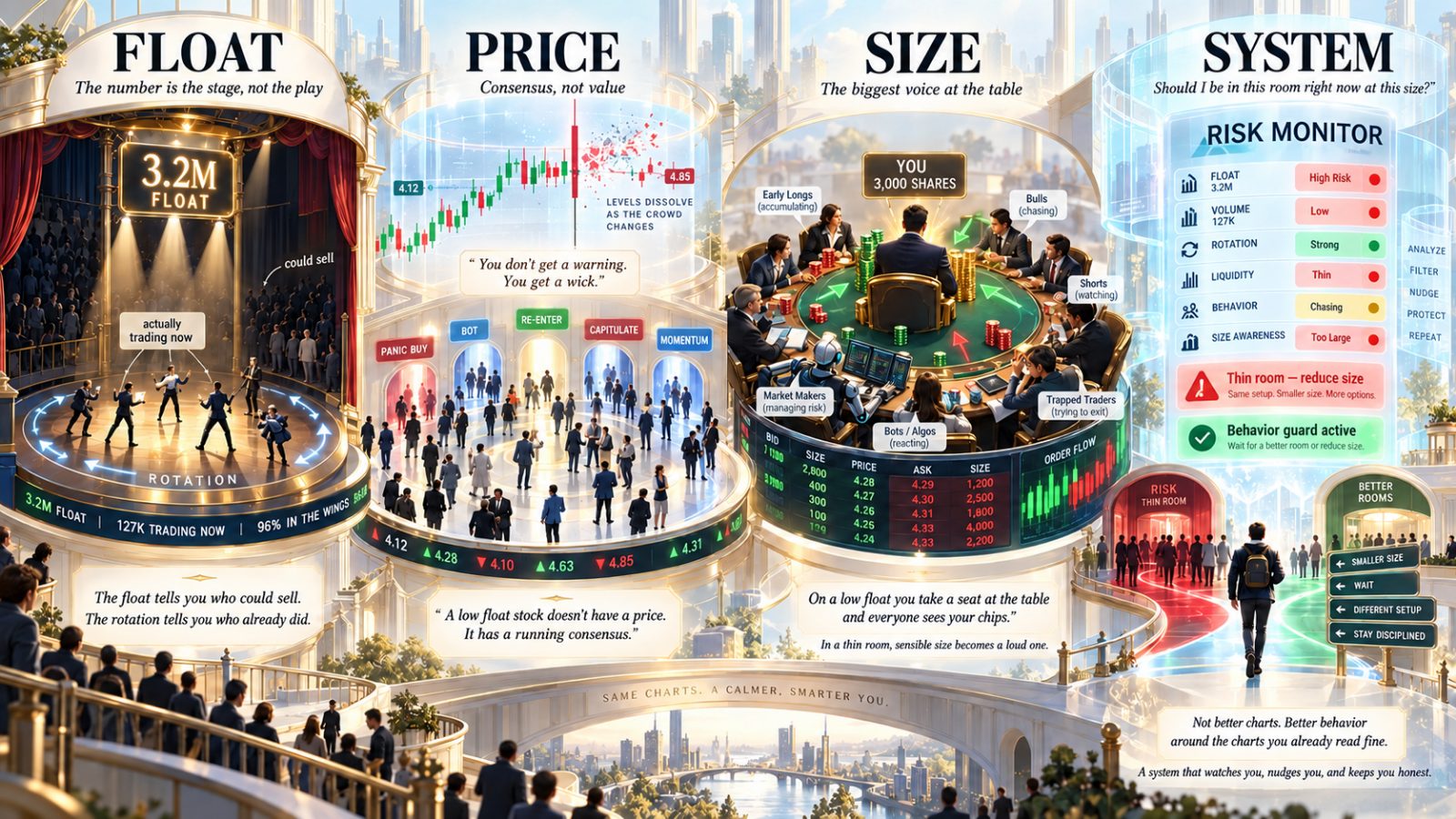
FLOAT
The number is the stage, not the play
Everybody who has been in small caps for more than a month knows what float means. Shares available to trade. Low number, less supply, more volatility. You've read the explanation forty times. The number sits in your scanner, color-coded.
What the number doesn't tell you is how much of it is actually moving. 3.2 million shares in the float does not mean 3.2 million shares in play. It means 3.2 million shares that could be in play, held by a mix of insiders, early longs, people underwater waiting to break even, people green waiting to see what the next ten minutes do. On any given morning, maybe 400,000 of them are willing to be sold at any price near the current one. Often less.
The float tells you who could sell. The rotation tells you who already did. When the rotation hits the float early, which happens constantly on these names, the stock stops behaving like a stock. Every print after that is somebody choosing to re-enter a position they just left, or hold through pain they didn't plan for, or capitulate at a price they would have called insane an hour ago.
That isn't supply and demand. That's a room full of people negotiating under duress.
PRICE
Consensus, not value
On a liquid name, the bid and the ask converge on something approximating value. There are enough participants, with enough different theses and time horizons, that the average of their disagreements means something you can lean on.
On a low float, there aren't enough participants for the average to mean anything. Every print is two specific people disagreeing hard enough to transact. The next print is two different people, with a different argument. Maybe one of them is a bot that only shows up for 400 shares at a time. Maybe the other is a position trader who got stopped out at the open and panic-bought back in because the stock printed one green minute.
A low float stock doesn't have a price. It has a running consensus between whoever happens to be in the room, and the room's demographics change every forty seconds.
Which means your level, the one you drew pre-market with care, the one that held yesterday and the day before, holds exactly as long as the current demographic of the room agrees it should. When the room changes, the level evaporates. You don't get a warning. You get a wick.
SIZE
The biggest voice at the table
Here is what I didn't understand after the first blowup. On a liquid stock, your size is private. You take a thousand shares of a mega cap, nobody notices. The market absorbs you without a comment.
On a low float with 400,000 shares actually rotating, a 3,000-share clip is not private. It's visible on the tape. People reading the tape see you. Not you specifically, but the shape of you, the fact that someone just took a thousand-share lot off the ask. That changes the behavior of the next three participants, which changes the behavior of the next ten.
On a liquid stock you take a position. On a low float you take a seat at the table and everyone sees your chips.
The size that worked on your paper account, the size the risk calculator told you was fine, the size that matches your 1 percent rule, is calculated against the chart. It is not calculated against the room. In a thin room, a sensible size becomes a loud one, and loudness invites response. The response is not personal. It's just the room reacting to the fact that you are standing in it.
That's what took the $4,200. Not my setup. Not my stop. Not my size as a percentage of my account. My size as a percentage of what was actually trading at that specific minute. Different math. Nobody teaches it because nobody wants to admit the number on their position sizer is only half the equation.
SYSTEM
What this costs if you don't know you don't know
I would love to tell you the fix is a better scanner. It isn't. Scanners show you float. They show you volume. They show you rotation versus float. Great. You still have to translate those numbers, in real time, into should I be in this room right now at this size. That translation is not a chart skill. It's a situational awareness skill, and the market punishes you for the parts of it you haven't built yet.
What I actually needed, after that second blowup, wasn't more information. I had plenty of information. What I needed was a system that noticed, before I did, that I was about to walk into a room I had no business sizing into. A system that watched my own patterns, my own tells, the specific setups where I historically over-committed, and flagged the behavior before I rationalized my way past it.
That's the gap between knowing low float math and surviving low float math. It's the gap between reading about these dynamics in a blog like this one and actually not giving back $4,200 next Thursday when a 2 million float gapper fires your favorite setup at 9:33 and the room on top of it is a knife fight. Knowledge doesn't close that gap. A system that watches you, nudges you, and keeps you honest about which room you are walking into, does.
That's what MAKETZO is built for. Not better charts. Better behavior around the charts you already read fine.